Predictive Representation Learning for Manipulation via Streaming Egocentric 3D Hand Forecasting
Abstract
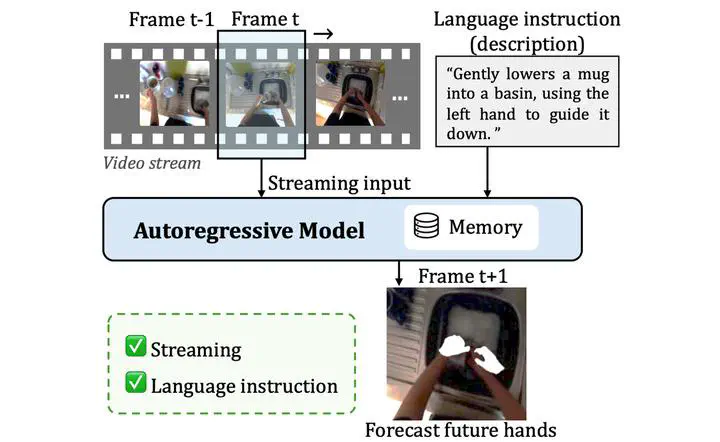
Learning embodied manipulation from egocentric human data offers a scalable path, reducing the cost of collecting robot-specific demonstrations. However, existing representation learning methods largely stop at perceptual understanding, such as extracting what a scene contains or what an action is. A capable embodied agent is more than understanding: it predicts the next motion. We propose that forecasting 3D human hand motion is one suitable pretraining task, as the representation jointly learns how to manipulate objects and how the motion will unfold next. Building on this hypothesis, we introduce SFHand, the first representation learning method via streaming egocentric 3D hand forecasting. SFHand learns by autoregressively predicting future 3D hand states, including hand type, 2D bounding box, 3D pose, and trajectory, from a continuous stream of video and language instructions. Its autoregressive architecture is equipped with an ROI-enhanced memory layer, capturing temporal context while focusing on salient hand-centric regions. To enable this research, we also introduce SFHand, the first open-source large-scale dataset pairing synchronized 3D hand poses with fine-grained language instructions (247K clips, 3.95M frames). Transferred to downstream embodied control, the learned representation shows state-of-the-art performance on both simulation and real-world manipulation benchmarks, improving success rate by up to 13.4%. Our method also achieves leading 3D hand forecasting accuracy, with 35.8% lower ADE than baseline methods. These results suggest that forecasting hand motion is a better pretraining task for representation learning in embodied manipulation.